
Background
- The Constitution of India originally set the allocation of seats in the Lok Sabha and State Legislative Assemblies on the basis of population.
- The maximum number of Lok Sabha seats was fixed at 500. With the adoption of universal voting rights, this limit was found inadequate.
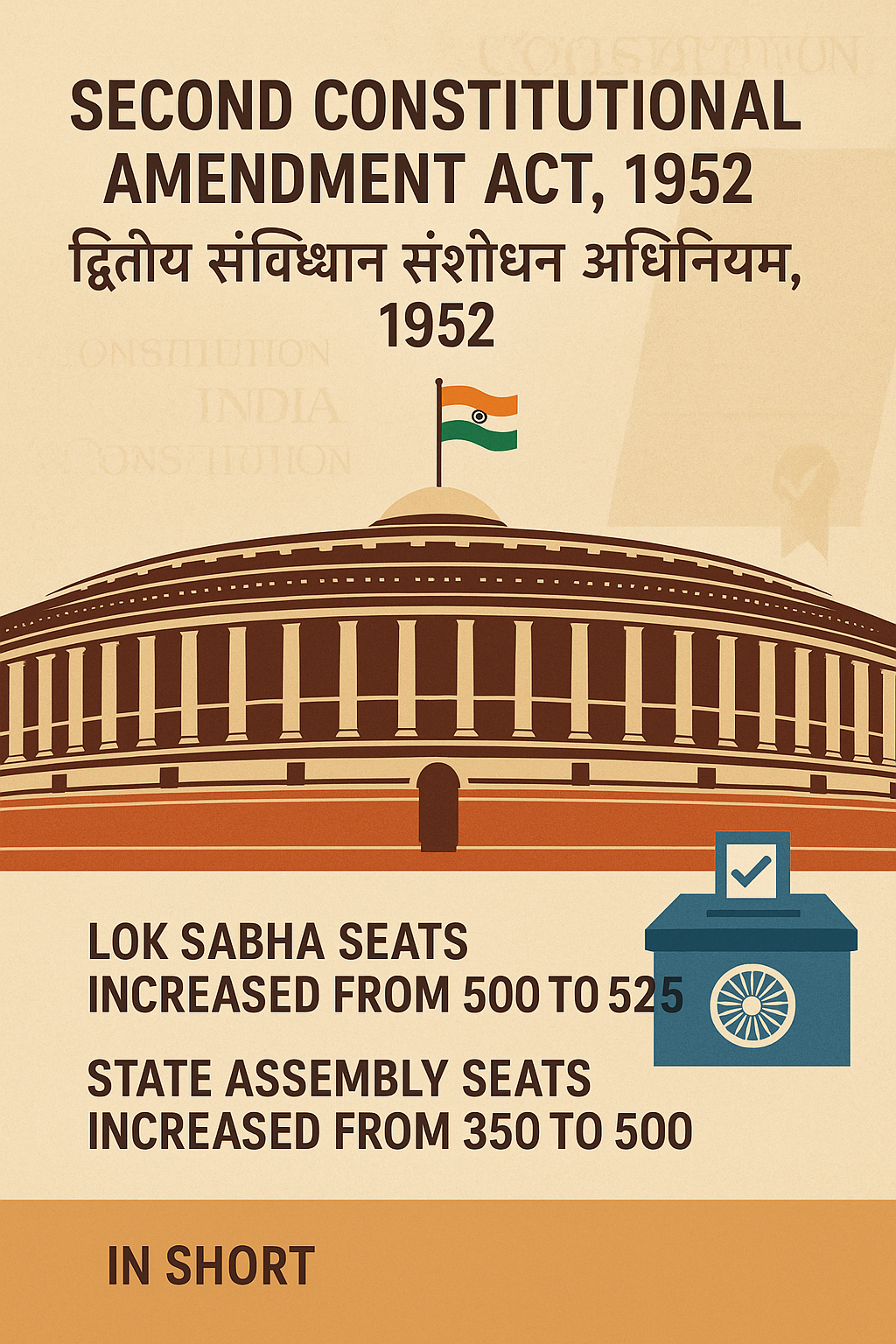
- To resolve the issue, the Parliament passed the Second Constitutional Amendment Act in 1952.
Main Provisions and Key Facts
- Increased the maximum number of Lok Sabha seats from 500 to 525.
- Increased the maximum number of State Legislative Assembly seats from 350 to 500.
- Representation of states in the Lok Sabha was linked to population, while maintaining proportional representation.
- Changes were made to Article 81 and Article 170 of the Constitution.
Significance
- Provided better representation for India’s growing population in Parliament and State Assemblies.
- Strengthened democracy by accommodating universal voting rights.
- Created a basis for future delimitation of constituencies.
Criticism and Limitations
- The amendment only adjusted numbers, without solving the deeper issue of unequal population distribution.
- Debates on delimitation and fair representation continued.
Key Points for Exams
- Year – 1952
- Articles – Article 81 (Lok Sabha), Article 170 (State Assemblies)
- Lok Sabha seats – raised from 500 to 525
- State Assembly seats – raised from 350 to 500
- Objective – adjustment of representation after adoption of universal voting rights
In Short
The Second Constitutional Amendment Act, 1952 increased seats in the Lok Sabha
and State Assemblies to provide fairer representation after the adoption of
universal voting rights.





Comments (0)
Leave a Comment